
Essential Horse Barn Features: What to Include and Why
For our customers, building a horse barn starts with layout: how horses, people, and equipment move through the space every day. Once that foundation is set, the next step is deciding which horse barn features your building needs on day one and which can be added as the operation grows. Choosing what belongs in your equestrian building now and knowing what future additions are possible can be valuable when you work with your post-frame builder.
1. Dutch Doors & Windows

The stall window and door features you choose depend mostly on the look and function you want. A Dutch window, also called a bale door, lets horses hang their heads out toward a paddock or grass lot. A Dutch door gives you the option to open the top half while keeping the bottom half closed. Slide doors and stall windows with bar grating are also available for barn stalls where a swinging door is not practical.
2. Wash Bay
If you compete, board horses, or work with a vet or farrier regularly in your barn, plan for a wash bay. In northeastern Indiana and northwestern Ohio, seasonal extremes make that case even stronger for anyone who needs to bathe horses year-round.
If you are not ready to build one yet, rough in the plumbing before the slab is poured. Several of our clients have used that space for storage and converted it into a working wash bay once their operation grew into it. Plan for at least 10 by 12 feet with a 10-foot ceiling, though 12 by 14 with 12-foot clearance gives you more room to work safely around a moving horse.
We ensure wash bays have proper drainage, non-slip footing, and frost-free plumbing, so the space stays safe and functional. For wall surfaces, we recommend TRU-Score, a PVC liner product that stands up to moisture and cleans easily.
3. Horse Barn Tack Room
A dedicated tack room protects riding gear and horse care supplies. We ensure tack rooms are accessed from inside the barn, not from an exterior door. Saddles, blankets, and discipline-specific gear are expensive, and keeping that entry interior is a simple way to protect the investment.
Our customers usually choose to have this area temperature-controlled for their own comfort and because leather holds up better when it’s not going through freeze-thaw cycles or sitting in the summer heat.
A private barn with one or two horses often has one 10-by-12-foot room. Boarding operations, training facilities, and competition horses require more room, since multiple saddle sets, discipline-specific gear, blankets, and show equipment accumulate quickly.
Post-frame construction makes expanding a tack room more manageable than other building types. Starting with one room and converting an adjacent stall later by removing a partition wall is a common approach as operations grow.
4. Horse Barn Feed Storage
Designing feed storage comes down to three necessities: getting it inside easily, making it accessible, and keeping pests out.
An exterior door dedicated to feed delivery keeps incoming hay and grain out of the main aisle and away from occupied stalls. For grain, sealed metal bins and a concrete floor are the most effective deterrents against rodents.
For hay, the approach depends on the operation. Some customers want a loft above the stalls where hay loads from the upper level and drops directly into stalls, eliminating the need to carry it down the aisle at every feeding. Others prefer open-air storage at ground level, where air can move freely around the bales. For smaller private barns, a dedicated ground-level area nearby is usually sufficient.
A lot of our customers start with a converted stall and use that as their feed room. If the operation grows and they need the stall back, feed can move to another location.
5. Horse Barn Grooming Areas
For a private barn with light traffic, grooming in the center aisle with cross-ties may suffice. For boarding operations and training facilities where multiple horses are being handled at the same time, a dedicated grooming stall moves that activity out of the aisle and keeps traffic flowing safely.
A grooming stall also serves as a designated space for farrier and veterinary visits, keeping those appointments from disrupting the rest of the barn. Positioning it across from the tack room also makes the daily routine more efficient.
One detail worth getting right early: tie-off placement. Cross-ties and tie-offs need to be anchored into structural members, not cosmetic boards. It is an easy thing to overlook in the planning stage and a harder fix once the barn is built.
6. Aesthetic Touches
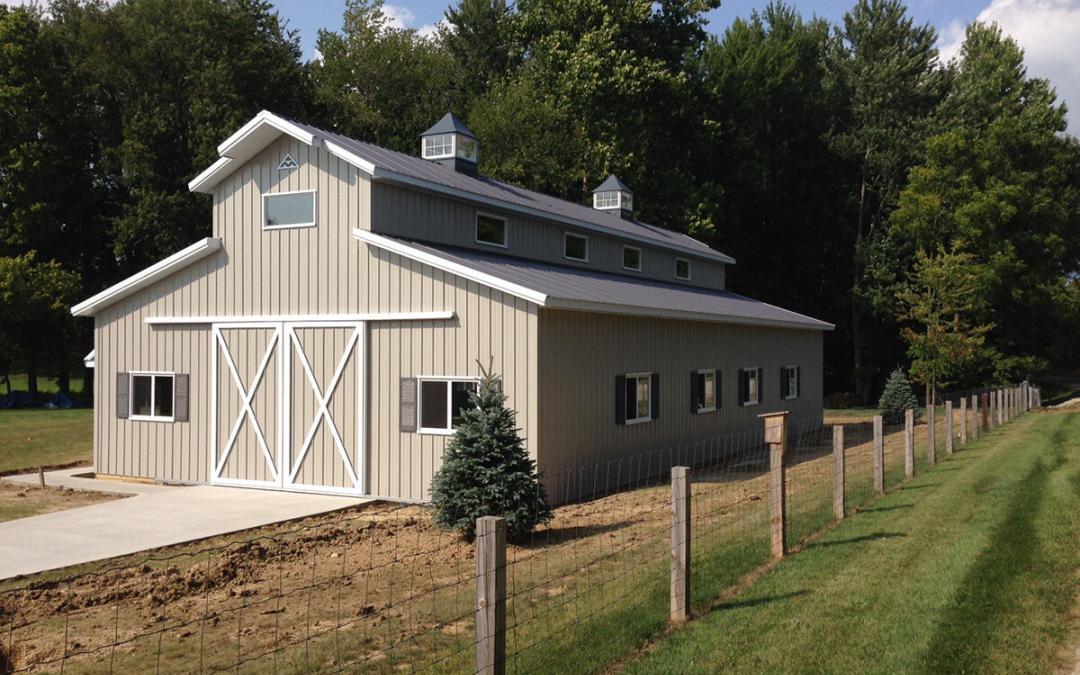
For many horse owners, the barn is the centerpiece of their property. Cupolas, weathervanes, wainscoting, board and batten siding, window trim, and fade-resistant paint colors are the details that bring that vision to life.
Porches and awnings add character while also providing functional shade and shelter. We have also used Dutch door panels mounted below windows as a purely decorative element, giving the exterior a classic equestrian look without adding a functional door.
Horse Barn Features Spotlight: Watcher’s Run Stables
When Brad Boyer and his daughter Rachel planned Watcher’s Run Stables in Noblesville, Indiana, the facility had to support boarding, training, breeding, and riding lessons at the same time. Every feature decision was centered on how the facility operates on its busiest days.
Their hay mow drops feed directly into stalls from above, eliminating aisle traffic at every feeding. The wash bay stays separated from dry working areas. The tack room keeps gear organized and within arm’s reach of daily riding routines. The result is a facility that runs multiple programs without any one use getting in the way of another.
Plan Your Horse Barn Features with Meyer Building
If you are ready to talk through what your horses and your operation actually need, call us at (260) 565-3274, or contact us online to begin the conversation. We can help you think through what belongs in the original build and what can wait as your operation grows.